

Your best source on science and technology news from Turkmenistan
Provided by AGP
Qoder Version 1.0 Released: Full Automation of Code Generation, Verification & Delivery
SINGAPORE, May 16, 2026 (GLOBE NEWSWIRE) -- Qoder officially releases version 1.0, upgrading from an AI IDE to an Autonomous Development Desktop. The new version enables autonomous execution of code generation, verification, and delivery workflows through AI-powered Experts. Qoder 1.0 is now available for download on Windows, macOS, and Linux.
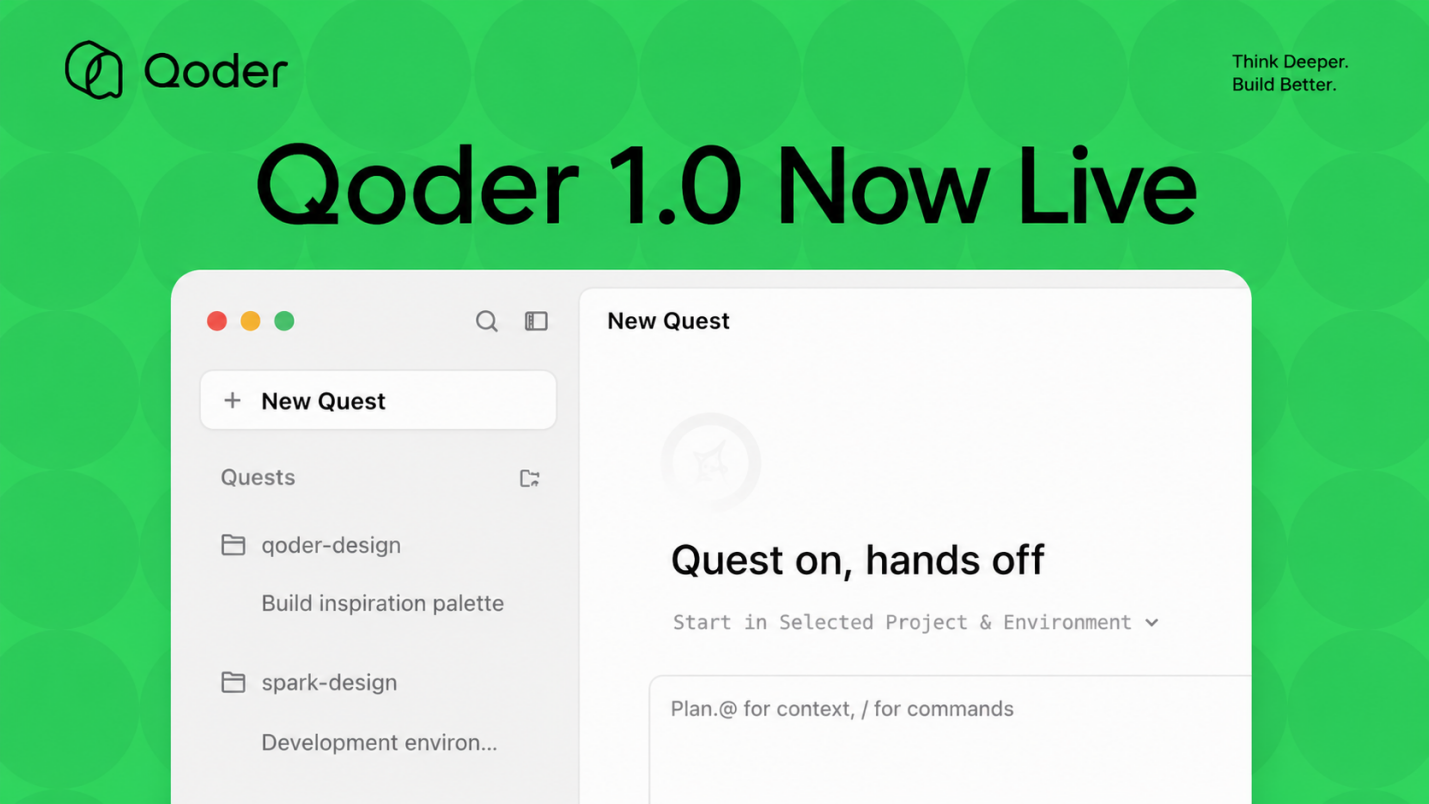
Qoder 1.0 delivers a comprehensive agent-centric interaction upgrade, introducing the all-new Quest window, which integrates task management, status tracking, artifact review, and knowledge invocation. After a user inputs requirements, execution, verification, and delivery can all be completed autonomously by the Agent within the workspace.
Qoder 1.0 also supports cross-project parallel multitasking. Users can monitor overall progress from a single screen without switching between windows, significantly boosting development efficiency for complex projects.
On the enterprise front, Qoder 1.0 consolidates previously scattered Memory, Repo Wiki, and Knowledge Cards into a unified knowledge engine. Built on a team-level knowledge sharing mechanism, it enables individual expertise to be rapidly distilled into organizational capability. For example, Agents can automatically invoke team conventions, historical decisions, module relationships, coding standards, and tech-stack knowledge during task execution. Internal data shows that after the knowledge engine went live, code retention improved by 11%, input token consumption dropped by 40%, and conversation turns decreased by 33%.
According to Qoder, these new capabilities are powered by upgrades to its Harness Engineering layer. Qoder has evolved the traditional chat dialogue into a structured Task Runtime: the Agent’s execution process is structured into a reviewable artifact chain, with clear ownership and status at every step.
Furthermore, Qoder has transformed fragmented context supply into runtime-spanning knowledge engineering — Agents can automatically invoke scope-appropriate knowledge during planning, generation, and review phases, effectively solving the noise problem inherent in traditional similarity-based knowledge retrieval.
By combining autonomous execution, structured task runtime, and team-level knowledge engineering, Qoder 1.0 aims to help developers and teams improve development efficiency, reduce repetitive communication, and maintain higher-quality code output across complex projects.
The Qoder family now comprises six products — Qoder IDE, Qoder CLI, Qoder JetBrains Plugin, Qoder Mobile, QoderWork, and QoderWake — serving over 5 million users worldwide.
Looking ahead, Qoder will continue to deepen its agent-centric development workflow and enhance the capabilities of its Autonomous Development Desktop. The company plans to further improve task execution, verification, delivery, and knowledge invocation across complex software engineering scenarios, helping users and teams move from AI-assisted coding toward more autonomous software development.
About Qoder
Qoder is an AI-driven software development platform focused on autonomous coding, knowledge engineering, and intelligent developer productivity solutions. The company provides AI-powered tools and workflow systems designed to support individual developers, engineering teams, and enterprise-scale software delivery.
Media Contact
Company: Qoder
Contact Person: Qoder Marketing
Email: contact@qoder.com
Website: https://qoder.com
A photo accompanying this announcement is available at https://www.globenewswire.com/NewsRoom/AttachmentNg/764a2cc3-c121-4447-a898-1650bf613b84

Qoder Version 1.0 Now Live
Qoder officially releases version 1.0, upgrading from an AI IDE to an Autonomous Development Desktop.
Legal Disclaimer:
EIN Presswire provides this news content "as is" without warranty of any kind. We do not accept any responsibility or liability for the accuracy, content, images, videos, licenses, completeness, legality, or reliability of the information contained in this article. If you have any complaints or copyright issues related to this article, kindly contact the author above.
